Stereotactic Radiation Therapy for Brain Tumour
What is stereotactic radiosurgery?
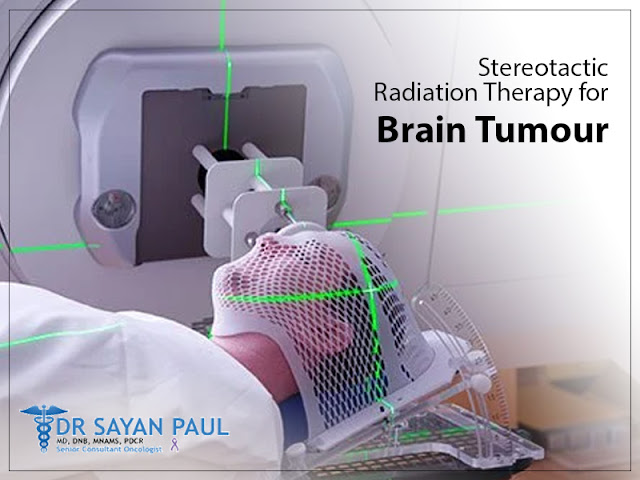
Stereotactic radiosurgery (SRS) is a non-surgical procedure to destroy small brain tumours and functional abnormalities of the brain. It is a highly accurate form of radiation therapy with an accuracy of within one to two millimetres. SRS can also be applied to the treatment of body tumours and the procedure is known as stereotactic body radiotherapy (SBRT).
In Kolkata, stereotactic radiosurgery is available in several hospitals. This radiosurgery is made possible by highly advanced radiation technologies that permit the maximum dose within the target with minimal effect on the surrounding healthy tissue.
How does it Work?
The procedure of SRS and SBRT rely on several technologies –
Localization techniques and three-dimensional imaging to determine the exact coordinates of the target within the body.
Systems to prevent movement and carefully position the patient and maintain the same patient position during therapy
Highly concentrated gamma-ray or x-ray beams are targeted on a tumour or abnormality.
Image-guided radiation therapy (IGRT) confirms the location of a tumour before and in some cases during radiation delivery. IGRT improves the treatment precision and accuracy.
SRS is commonly a one-day treatment. However, stereotactic radiation therapists in Kolkata sometimes recommend multiple stereotactic delivered therapies. Multiple sessions are necessary for tumours larger than one inch in diameter as the exposure of the surrounding normal tissue to the single high dose of radiation must be respected and limited. The effect of radiation on normal tissue increases proportionally to the tumour size.
Delivering the radiation in multiple sessions instead of one improves safety. It facilitates the healing of the normal tissues between treatments. This procedure is known as fractionated stereotactic radiotherapy (SRT).
Effective alternative to Invasive Surgery
In Kolkata, stereotactic radiation therapy is effectively used for patients unable to undergo surgery and for tumours and abnormalities that are:
hard to reach
located close to vital organs/anatomic regions
subject to movement within the body
SRS is used to treat several brain tumours, including:
benign and malignant
metastatic and primary
single and multiple
tumour cell residue following surgery
tumours located in intracranial, orbital and base-of-skull
Arteriovenous malformations (AVMs) - blood vessels tangle and disrupt normal blood flow in the brain and sometimes bleeds.
Other neurological problems like trigeminal neuralgia (a nerve disorder in the face), tremors, etc.

Comments
Post a Comment